Manufacturing documentation
Assembly drawings, build notes, revision control and the specification of the product as built rather than as imagined.
T · [CLIENT TO PROVIDE] E · [CLIENT TO PROVIDE]
Overview
Prototype builds survive on knowledge that lives in people's heads: which component orientation is correct, which test to run first, which measurement matters. Production cannot run on that, and it fails in ways that are hard to trace when it tries.
Production readiness is the work of converting that knowledge into documentation, data and tooling. Every assumption is written down, every build step is specified, every test has a defined pass criterion.
Done properly, the first volume build is uneventful. That is the objective: not an impressive launch, but an unremarkable one.
Readiness scope
A complete, unambiguous definition of the product as it will be built.
Assembly drawings, build notes, revision control and the specification of the product as built rather than as imagined.
Fabrication data, assembly data, verified bill of materials with alternates and approved supplier information.
A defined test sequence with pass criteria, sized for build volume and cycle time and runnable by production staff.
Fixtures, harnesses and test software so results are consistent between operators, shifts and sites.
Process compatibility review, panelisation, handling requirements and anything the assembler needs to know in advance.
Review of the first production units against the documentation, with findings resolved before volume begins.
Transition process
A structured handover rather than an email with a folder of files attached.
Stage 01
An honest review of what exists: documentation, test evidence, open issues and undocumented knowledge.
Stage 02
Changes closed out and a controlled baseline established, so everyone is building the same revision.
Stage 03
Assembly, test and build documentation written to the level a new operator could follow.
Stage 04
Production test sequence agreed, coverage decided and fixtures specified or built.
Stage 05
Data package issued, manufacturer queries resolved and process compatibility confirmed.
Stage 06
First units built and reviewed against documentation, with discrepancies corrected in the documentation.
Stage 07
Production ramped with a defined route for issues and design changes after launch.
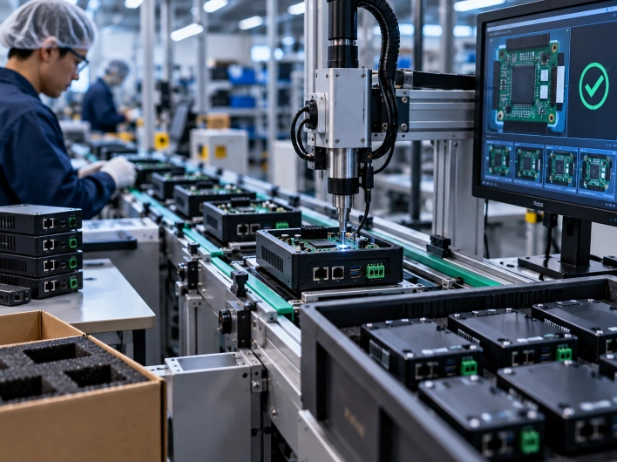
Handover
Prototype builds run on knowledge held in people's heads: which orientation is correct, which test to run first, which measurement matters.
Production readiness is the work of converting that into documentation, data and tooling — so the build no longer depends on who is in the room.
Applications
Usually right before it feels necessary — which is why it is worth planning in advance.
Earlier than most teams expect. Test access, panelisation and component choices all affect manufacturability, and they are far cheaper to address during design than after the layout is frozen.
We provide production engineering, documentation and build coordination. In-house manufacturing capability is to be confirmed by the company; where builds are carried out by manufacturing partners, we prepare the package and support the process.
Fabrication and assembly data, a verified bill of materials with alternates, assembly documentation, test specification and fixture information, plus the revision control that ties it all to a specific baseline.
Yes. That work centres on making the documentation complete enough that a new manufacturer can build the product without the original team, which frequently exposes gaps worth closing regardless.
Related
We can assess what is missing and build the documentation, test strategy and data package that production needs.
DFM, supplier and build coordination.
Open →02Assembly-ready boards and build validation.
Open →03Functional and reliability testing of built units.
Open →04Verification across hardware and firmware.
Open →05Concept to production-ready electronics.
Open →Next step
Tell us what the product has to do and we will tell you what engineering it needs.