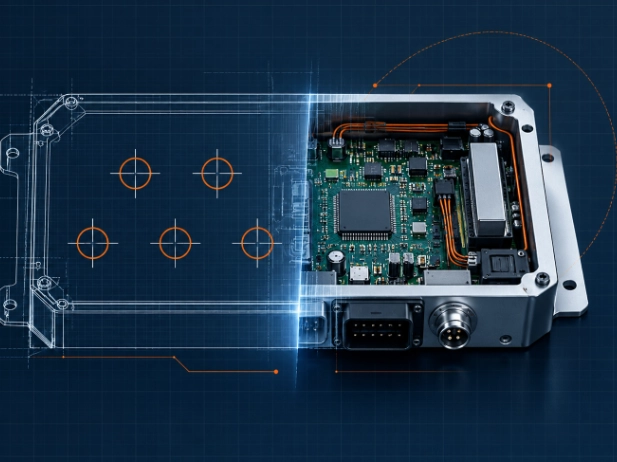
Control and I/O boards
Digital and analog I/O with protection, isolation where needed and predictable behaviour under fault conditions.
T · [CLIENT TO PROVIDE] E · [CLIENT TO PROVIDE]
Sector challenge
Industrial environments combine conditions that each individually complicate electronics design: wide temperature swings, mechanical vibration, electrically noisy supplies, inductive switching nearby and dust or moisture ingress.
They also impose expectations that consumer products never face — years of continuous operation, servicing by technicians rather than manufacturers, and availability of spares long after the original components have gone end-of-life.
Designing for this means margin in the right places, protection on every exposed interface, thermal behaviour that has been measured rather than estimated, and component choices made with a ten-year view.
Engineering principles
Electronic systems
Most projects combine several of these on one assembly.
Digital and analog I/O with protection, isolation where needed and predictable behaviour under fault conditions.
Supply stages designed for wide input range, transient tolerance and continuous thermal load.
Measurement front ends that stay accurate in the presence of industrial electrical noise.
Wired interfaces engineered for cable length, noise immunity and fault recovery.
Deterministic control firmware with defined safe states and diagnostic capability.
Surge, ESD and isolation strategy planned as part of the architecture, not added at the end.
Constraints
| Constraint | Why it matters here | How it is addressed |
|---|---|---|
| Electrical noise | Switching equipment injects transients onto supplies and signals | Filtering, isolation and layout partitioning designed from the architecture stage |
| Thermal load | Enclosures restrict airflow and ambient runs high | Thermal behaviour measured on real hardware in representative enclosures |
| Component lifecycle | Products outlive typical component availability | Lifecycle and second sourcing reviewed during selection |
| Serviceability | Field technicians diagnose and repair, not engineers | Diagnostics, test points and clear fault indication designed in |
Service life
Industrial equipment is diagnosed and repaired by technicians in the field, often years after the design team has moved on.
Diagnostics, test access and clear fault indication are therefore design requirements, not conveniences.
Applications
Typical products
Engineering emphasis
Capabilities
The disciplines below carry most of the work in this field.
Applied to this sector.
Open → 02Applied to this sector.
Open → 03Applied to this sector.
Open → 04Applied to this sector.
Open → 05Applied to this sector.
Open → 06Applied to this sector.
Open →We design with the relevant environmental and electrical requirements in mind and prepare products for compliance activity. Specific standards coverage and certification support are to be confirmed: [CLIENT TO PROVIDE].
Yes. That is one of the most common industrial requests. It usually starts by recovering the documentation and behaviour of the existing board before deciding how narrowly the change can be scoped.
Through component lifecycle review at selection, documented design intent so the product can be supported by others, and diagnostics that make field faults explainable years after launch.
Related
The engineering discipline transfers; the constraints do not.
Automation asks electronics to do two things at once: hold a deterministic con…
Open →02Consumer products compress advanced electronics into small enclosures at tight…
Open →03Healthcare electronics are judged on accuracy, repeatability and the ability t…
Open →04Vehicle electronics face wide temperature ranges, electrical transients, vibra…
Open →05Connected products are easy to demonstrate and hard to sustain. The engineerin…
Open →Next step
Tell us what the product has to do and we will tell you what engineering it needs.