Functional testing
Structured verification that each function behaves as specified across the intended operating range, not just at nominal conditions.
T · [CLIENT TO PROVIDE] E · [CLIENT TO PROVIDE]
Trying it produces confidence. Testing it produces evidence.
Overview
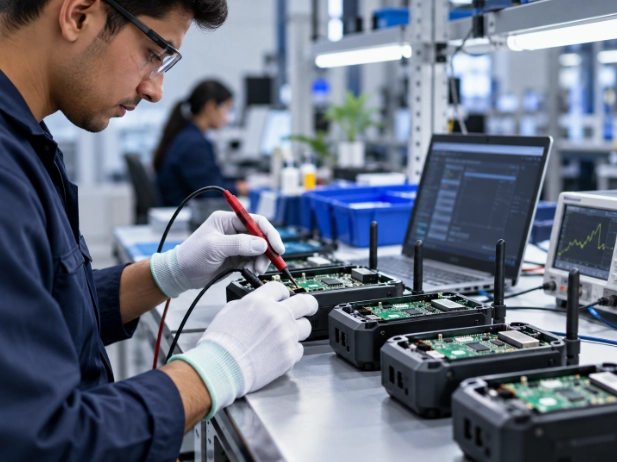
There is a meaningful difference between a product that has been tried and one that has been tested. Trying it produces confidence; testing it produces recorded results against defined expectations, repeatable by someone else.
We define what has to be proven, build the test sequence and fixtures needed to prove it, run it on real assembled units and record the outcome — including the results that were not what we hoped for.
The same work usually produces the production test strategy, because the tests that prove a design is right are closely related to the tests that prove a build is correct.
Testing scope
Different questions need different tests. Running the wrong one carefully still proves nothing.
Structured verification that each function behaves as specified across the intended operating range, not just at nominal conditions.
Accuracy, timing, throughput, power draw and other measurable characteristics compared against the requirement.
Behaviour at the edges of supply, temperature, load and input range, to find where margin actually ends.
Extended operation, power cycling and repeated-use testing to expose failures that a short test never reaches.
Fixtures and harnesses that make a test repeatable by anyone, which is what turns a result into evidence.
A test sequence sized for build volume and cycle time, covering the faults that actually occur in manufacture.
Test process
Defined before the units exist, so the design can support being tested.
Requirements turned into testable statements with pass criteria that are measurable rather than subjective.
Sequence, conditions, instrumentation and sample size chosen to answer each statement.
Fixtures, harnesses and test software built so the test can be run consistently and repeatedly.
Tests run on real units with conditions and results recorded as they happen.
Results compared against criteria, failures investigated to root cause rather than retested until they pass.
Documented outcomes, with findings fed back into design or production as appropriate.
Applications
Any time a failure in the field is more expensive than the test that would have caught it.
Enough to cover the failures that would be expensive. We work backwards from consequence: what would a field failure cost, how likely is it, and what is the cheapest test that would catch it before shipping.
Yes. Production test is a separate discipline from design verification — it has to be fast, repeatable and run by production staff. We design the sequence and the fixture together, ideally while the board can still be changed to support it.
We prepare products for compliance testing and support the process, but accredited certification testing is carried out by qualified laboratories. Our specific compliance support scope is to be confirmed: [CLIENT TO PROVIDE].
The test specification, fixtures and test software where developed, recorded results and a report that states what was proven, what failed and what remains untested.
Related
Tell us what has to be proven and how the product is used. We will design a test programme that proves it.
Verification across hardware and firmware.
Open →02Assembly-ready boards and build validation.
Open →03Documentation, tooling and build packs.
Open →04DFM, supplier and build coordination.
Open →05Architecture, circuits and board-level design.
Open →Next step
Tell us what the product has to do and we will tell you what engineering it needs.